Sleepless in Poipu
A Vacationer’s Guide to Birding on Kauai

If, for most of your life, you’ve been a lazy birder like me, you prefer it when the birds come to you, as opposed to traveling for the sole purpose of birding. Not just on the backyard feeder, but also out in the wild. Nothing beats a day fly-fishing when a Belted Kingfisher, for example, enhances my experience by perching on a branch on the riverbank and hangs out, long enough for me to wrangle my fly and focus my binoculars. I’m not there to bird, but nonetheless, I bird. This explains why I’ve only recorded a couple hundred (of the world’s ten thousand!) bird species on my “life list.” Quite abysmal.
As underachieving as I am, however, I have chalked up a few dozen of the birds on my list while on vacation, which I see as a win-win. No matter where you go, from Ambergris Caye to Monterey Bay, there are birds–different and exciting birds, all dwelling in a wide range of habitats. Birding adds another layer of intrigue to a place, and for me, an additional “To Do” to my travel itinerary. But only if I’m already going there.
This is why I was thrilled when our friends invited us to join them on a trip to the Hawaiian island of Kauai. My number one priority was to enjoy the island with the friends and my husband, of course. But second was birding. I had visited some of the other islands and accidentally saw a few birds, and I knew Kauai held species not on the other islands. So I packed binoculars into my carry-on, with the books I probably wouldn’t get around to reading and the neck pillow I rarely use.
The first bird you will see on Kauai is the Red Junglefowl, which the Hawaiians call moa. It looks like a chicken (Gallus domesticus), but it’s different, Gallus gallus. In A Photographic Guide to the Birds of Hawai’i, the fowl is included in the chapter on forest birds, but believe me–these flamboyant creatures are everywhere. I saw the first one when we exited the airport and excitedly remarked, “Look, a moa!” and then my companions and I chuckled when we saw them in every yard and parking lot on the 45-minute drive to the condo on the southern curve of the island. We affectionately called them Jason Mo-Moas (he’s everywhere).
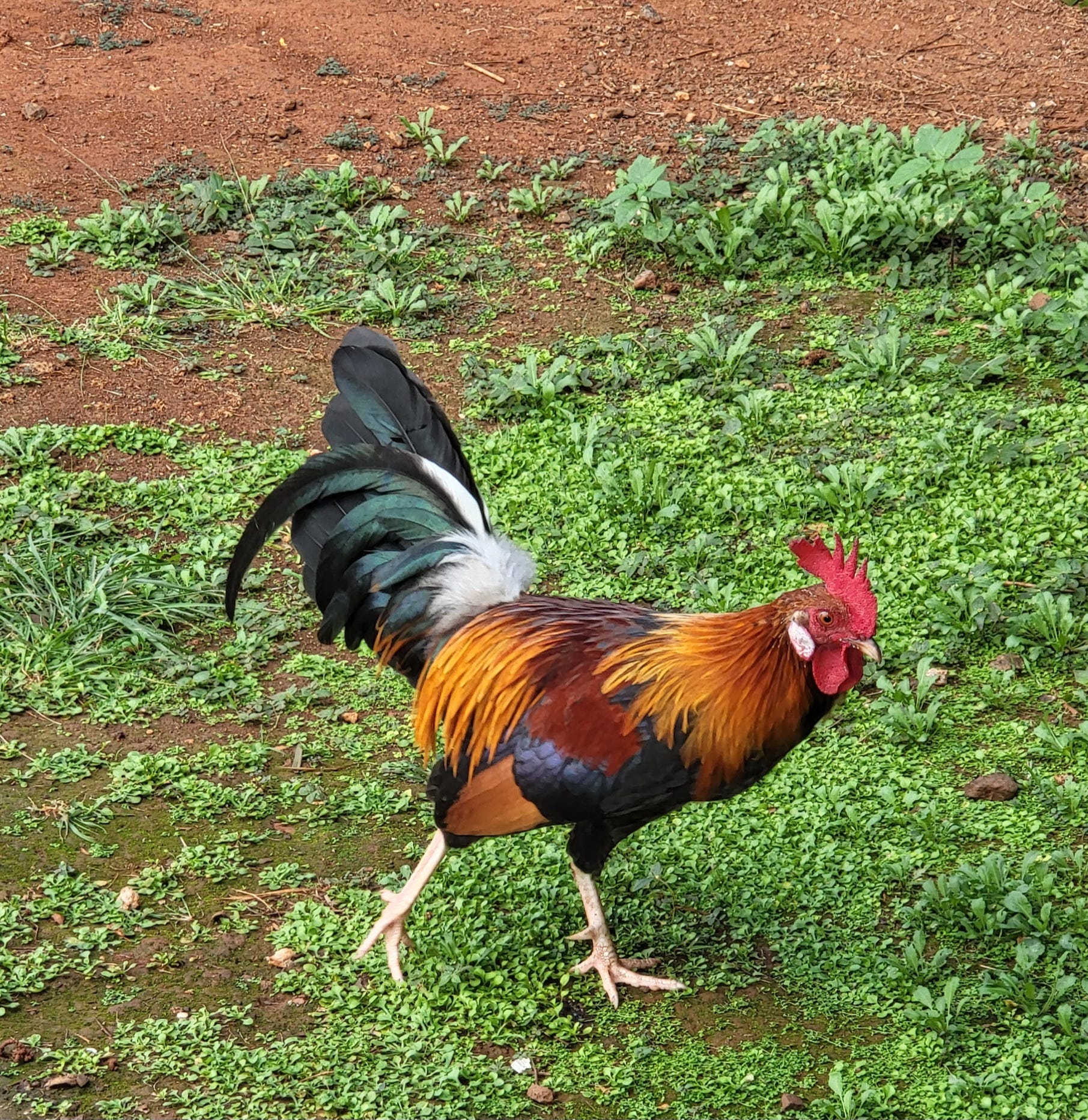
The first and last bird you will hear, at 3 a.m., 5 a.m., 6, 7, 8—all day and night, is the moa. They don’t crow at dawn like dutiful farm chickens, oh no; these winged trumpets announce the rising of the moon, the stars, the flicker of streelights. Lying in bed, you can hear a faint, scratchy er-er-er-er-errrrrr miles away, far up the beach, igniting a chain of heralds like signal fires that gets louder and louder until they reach the three competing cocks surrounding your beach condo, who try to outdo each other for a good twenty minutes. This nerve-trashing roll call continues down the coast and starts all over again an hour later. I barely dared to attempt sleep, instead lying there stiff and petrified, ears pricked for the next far away caw-caw.
This isn’t an essay about Kauai travel tips, but heed this: If you enjoy sleep, get a room with air conditioning so you can close the windows. That island breeze and the sounds of the waves are soothing, but they don’t drown out the cacophony. Earplugs don’t work, nor does trekking down three flights of stairs in your swimsuit coverup and pleading with the birds to quiet down. That is not effective.
If you inquire with the concierge about the birds, she will shrug and send you on your way with a smile that makes you feel like a dumb haole. Which, obviously I am, a white lady traipsing around one of earth’s most beautiful places and complaining about the lack of sleep. Yet, the once-native (as of 1500 years ago, brought by the Polynesians), now feral birds are ruffling enough local feathers that some plans to control them are in the works. Here are some sources on the history and perspectives on Hawaii’s “chicken problem.”
https://beatofhawaii.com/taming-kauais-roosters-hawaii-enacts-law-controlling-feral-chickens/
https://www.washingtonpost.com/opinions/2022/06/08/native-hawaiian-rights-chicken-problem/
https://www.nytimes.com/2015/04/07/science/in-hawaii-chickens-gone-wild.html
An awe-inspiring yet easy-to-attain bird experience on Kauai is the daily commute of the Rose-ringed Parakeet. There I was, minding my own business, enjoying the sunset at a popular restaurant on Poipu Beach, getting ussies with my group and the other hundred tourists, when a few of the most striking lime-green parakeets soared in, landing in the palm trees near the patio. CUTE! I snapped a few photos. But then, a few more arrived. Then a few dozen, then a chattering hoard of hundreds of parakeets, all squawking so loudly as they settled into the fronds above that you could hardly hear the ukulele music thrumming from the restaurant speakers. I was dumbstruck. More than a a few fellow diners actually looked terrified, as if re-living a scene from The Birds, but the version where people are sunburned and flushed with rum.
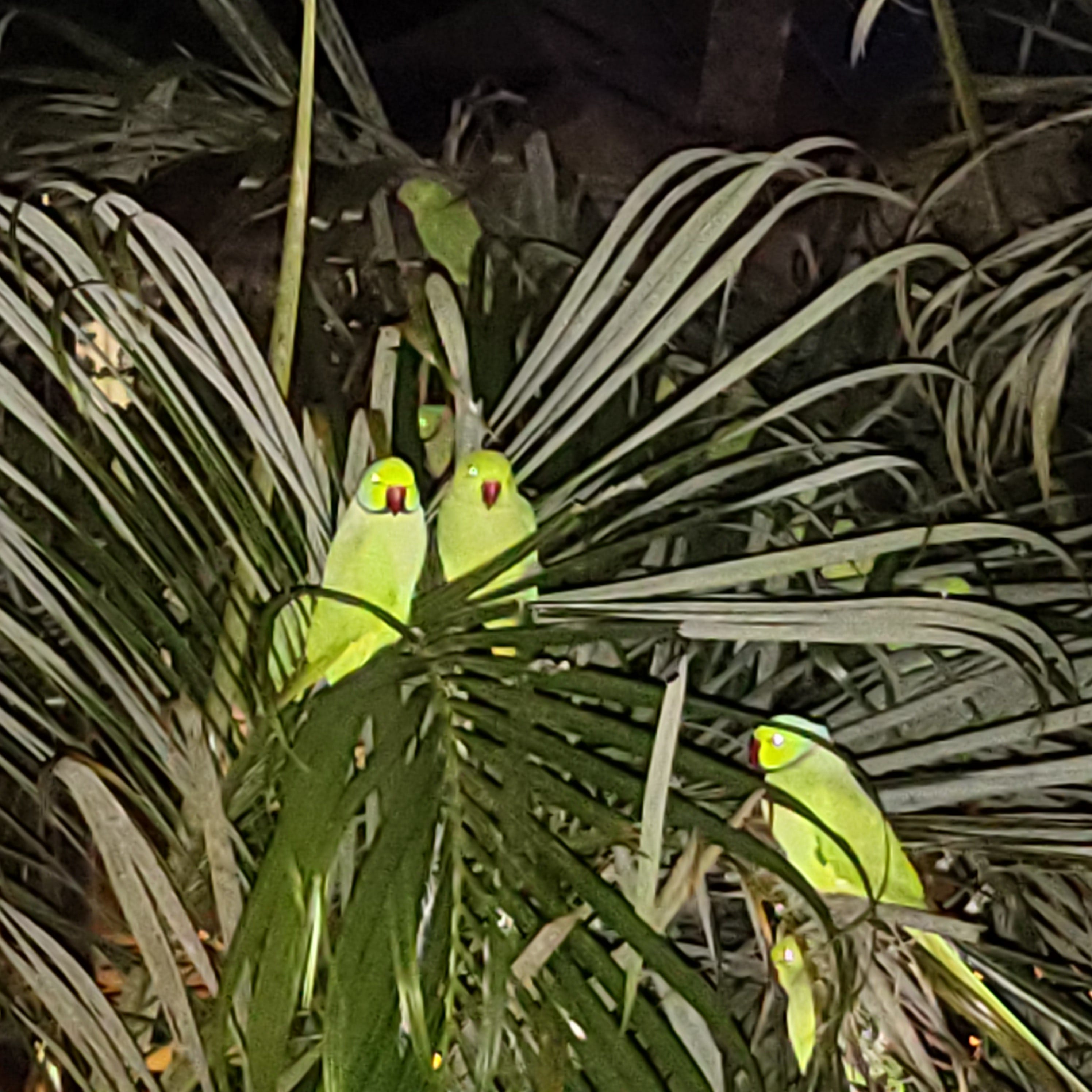
After about ten minutes, the throngs settled down, roosting for the night. Early in the morning (you’ll never miss a sunrise, thanks to the roosters), from the balcony of the condo, we watched the parakeets begin to stir and, as they did the night before but in reverse, one by one they alighted from the palms and headed north toward the mountains. A group, then groups of dozens, embarked on their morning ritual to gorge on fruits and berries, before returning again that evening. Like clockwork, the parakeets left every morning at 6:15 a.m. and returned at 6:15 p.m. The entire display of sound and color–and promptness–was impressive.
Mai Tais and Myna Birds
Here’s my list of some other neat birds you can spot without exerting much effort. Watch some clouds, watch some waves, and with an extra measure of observation, watch some new birds.
Cattle Egret: If you spot a herd of cows, you will surely see one of these large, elegant white birds, probably even chilling on top of a cow.
Common Myna. These are like the robins of the mainland, bopping around on the ground on lawns, in parking lots, etc.
Nene, the Hawaiian Goose: These are not super common, so I felt lucky to have spotted a few pairs of these here and there, mostly on rough, grassy with adjacent tall bushes.
Red-crested Cardinal. Easy-to-see bright red markings, often on top of fences and rooftops.
Spotted Dove and Zebra Dove. Both sweet little doves with different markings you can use to distinguish them.
Bird Ahoy!
I recommend (incoming travel tip!) Na Pali Coast Experiences for a guided tour of the famous and breathtaking Na Pali Coast. On that boat adventure, you will most likely see the White-tailed Brown Booby, the Red-footed Booby, the White-tailed Tropicbird, and if the boat cruises along the rocky faces and into caves as ours did, the Hawaiian Noddy, a smoky-brown, almost ghostly-looking bird fit for a pirate ship.
Aloha!
Recommended Book: A Photographic Guide to the Birds of Hawai’i.
Love the Moa! Thanks for the happy diversion. 💕 MN Nice
The parakeet scene at 6:15 sounds absolutley spectacular. That level of punctuality from a wild bird populaton is kind of wild to think about. Been to Kauai twice but never timed it right to catch those evening roosts, this makes me wanna go back just for that.